
PINTEREST INCOME GUIDE
I know how it feels when you want to learn how to make money on Pinterest but have no idea where to start. You see people talking about affiliate income, blog traffic, digital products, and online businesses, but the process can feel confusing and overwhelming. You may wonder what to post, how to attract the right audience, or how Pins can contribute to traffic and income.
Pinterest is more than a place to save ideas. It is a visual discovery and search platform where people look for solutions, products, and inspiration. With a clear strategy, you can build a system that attracts relevant visitors and connects that traffic with practical monetization opportunities.
At Pin Guides, you will learn how to set up your account, optimize your Pins for search, drive relevant traffic, and monetize it through affiliate marketing, blogging, digital products, and ecommerce.
QUICK ANSWER
Can You Really Make Money on Pinterest?
Yes — but Pinterest itself usually isn’t the thing paying you. A better way to think about it is as a discovery platform that can send the right people to something you already monetize, such as a blog, affiliate recommendation, digital product, Etsy shop, ecommerce store, or service.
The important part is what happens after someone clicks. A Pin can get plenty of views and still generate very little income if the destination is unclear, irrelevant, or fails to solve the visitor’s problem.
For beginners, the goal should be simple: create useful Pins around topics people are already searching for, send them to a relevant destination, and track which content actually leads to clicks, leads, or sales. Results take testing and consistency, and there is no guaranteed income.
Table of Contents
Jump to the section you need, from Pinterest monetization basics and income methods to niches, analytics, best practices, and your beginner roadmap.
FOUNDATION
What Is Pinterest Monetization?
Pinterest monetization works by using Pinterest to help the right people discover your content, click through to a relevant destination, and take an action that can lead to revenue.
That destination might be a blog post, affiliate recommendation, digital product, ecommerce store, Etsy listing, email signup page, or service. Pinterest itself is usually the discovery and traffic source; the actual income comes from what happens after the click.
A simple way to understand the process is:
Pinterest search → useful Pin → relevant click → destination → conversion
You do not need to chase viral Pins or focus only on follower count. A stronger strategy is to create useful content around topics people are already searching for, send them to the right destination, and track which Pins lead to meaningful clicks, leads, or sales.
1. Foundation
Choose a focused niche, audience, account setup, and destination before publishing at scale.
2. Discovery
Use Pinterest SEO and keyword research so Pinterest can understand the topic and match it with relevant users.
3. Traffic
Create Pins that earn qualified outbound clicks and send visitors to a page that continues the same promise.
4. Revenue
Connect traffic with a clear monetization path and measure conversions instead of assuming impressions equal income.
Four Core Pinterest Pillar Guides
Pin Guides is built around four core pillar guides, each covering a different part of the Pinterest growth process. The homepage brings those topics together and helps you see how they connect, while supporting guides such as Best Pinterest Niches go deeper into specific questions without becoming separate pillars.
The goal is to keep the learning path simple: start with the basics, understand Pinterest SEO, learn how to attract relevant traffic, and then explore monetization through affiliate marketing. Once those foundations are clear, the supporting guides can help you refine your niche, content strategy, account setup, and analytics.
Pinterest for Beginners
Set up your account, profile, boards, first Pins, and a simple publishing routine.
Pinterest SEO
Learn Pinterest keyword research, profile SEO, board relevance, Pin SEO, and destination alignment.
Pinterest Traffic
Turn visibility into useful outbound clicks with stronger creative, topics, landing pages, and measurement.
Pinterest Affiliate Marketing
Build a transparent affiliate system with relevant offers, clear disclosures, and trustworthy content.
INCOME OPTIONS
How to Make Money on Pinterest: 6 Practical Ways
There is no single way to make money with Pinterest. For most creators and small businesses, Pinterest works best as a discovery and traffic channel: someone finds your Pin, clicks because it matches what they need, and then reaches a product, article, offer, or service that can generate revenue. Understanding how to make money on Pinterest becomes easier when you separate the main monetization methods.
If you are just getting started, choose one primary monetization method first. Learn what kind of Pins attract the right visitors and what those visitors do after clicking before trying to build several income streams at once.
Affiliate disclosure:
Affiliate disclosure: Some links on Pin Guides may be affiliate links. If you make a qualifying purchase through one of these links, we may earn a commission at no additional cost to you. Affiliate relationships do not change our commitment to relevant and useful recommendations.
Affiliate Partnerships
Recommend relevant products or services and earn a commission when a qualifying purchase or action happens through your affiliate link.
Best for: product-led niches and tutorials.
Blogs and Content Sites
Use Pinterest to send readers to helpful articles that can earn through ads, affiliate links, products, or services.
Best for: publishers and long-term content sites.
Digital Products
Send Pinterest users to templates, printables, ebooks, courses, or other resources you create and sell.
Best for: creators with practical skills or expertise.
Ecommerce, Etsy, and POD
Promote products with Pins that closely match the product page or store visitors reach after clicking.
Best for: visual products, gifts, decor, fashion, and crafts.
Pinterest Services
Turn your Pinterest skills into client services such as account setup, Pin design, keyword research, or management.
Best for: freelancers and virtual assistants.
Sponsored Content
Partner with relevant brands for paid campaigns once you have a clear niche, consistent content, and audience credibility.
Best for: established niche creators.
NO BLOG REQUIRED
Can You Make Money on Pinterest Without a Blog?
Yes — a blog can be useful, but it is not the only way to monetize Pinterest.
Pinterest can send people directly to destinations such as an ecommerce store, Etsy product, digital-product page, service page, or—in cases where both Pinterest and the affiliate program allow it—an affiliate offer. Pinterest itself supports affiliate monetization and product-linked Pins, while third-party affiliate programs can have their own rules about where and how their links may be shared.
For a beginner, this can make the setup feel simpler because you do not have to build a full content website before testing an idea. For example, a useful Pin could lead someone to a printable you sell, a relevant product listing, or a page describing a service you offer. Printify and Hootsuite also describe direct affiliate links and product destinations as ways creators can use Pinterest without relying on a traditional blog.
But simpler does not always mean better. When you send visitors straight to a third-party platform, you have less control over the experience. Fees, affiliate terms, product availability, and platform policies can change, and you may have fewer opportunities to explain an offer or build an email audience before asking someone to buy. Tailwind therefore recommends helpful owned content as a stronger approach in many affiliate situations, even though a blog is not technically required.
Whatever destination you choose, make sure the Pin and landing page closely match. Pinterest specifically recommends that the image, text, keywords, and landing-page content remain relevant to one another.
For most beginners, the practical approach is to choose one clear path first—affiliate marketing, digital products, ecommerce, Etsy, or services—create Pins for people already interested in that topic, and measure what happens after they click.
If you are learning how to make money on Pinterest without a blog, focus on methods that do not depend on sending visitors to your own website. The goal is not simply to send traffic somewhere. The goal is to send the right person to the right destination with a clear reason to take the next step.
Which Pinterest Niches Have Monetization Potential?

A good Pinterest niche is not simply the topic getting the most views. It is a topic where people are actively looking for ideas or solutions and where you have a realistic way to help them take the next step—whether that means reading useful content, choosing a product, downloading a resource, or hiring a service.Choosing the right niche is an important part of learning how to make money on Pinterest because your topic needs both search interest and a clear monetization path.
Home décor, recipes, fashion, beauty, DIY and crafts are naturally suited to Pinterest because they are highly visual and closely connected to planning and discovery. Other niches, including business, education, digital products, wellness, and ecommerce, can also work when the content matches what people are searching for and leads to a relevant destination.
Instead of asking “Which niche makes the most money?”, ask whether you can create genuinely useful content around the topic, whether people are searching for it on Pinterest, and whether there is a clear monetization path behind that traffic.
Choose a topic you understand well enough to publish about consistently, then narrow it until the audience and purpose of your Pins are clear. A focused niche makes it easier to decide what to create, who you are creating it for, and what should happen after someone clicks.
Explore the best Pinterest niches for making money →Why Do Some Pinterest Accounts Grow While Others Stay Invisible?
Getting results on Pinterest is not just about posting beautiful images. Successful accounts understand what people are searching for, create content around those topics, and improve their strategy based on real performance data.
Our Pinterest marketing guide breaks down the process step by step — from finding the right keywords and creating optimized Pins to building a system that can generate consistent traffic over time.
Learn Pinterest Marketing Strategy→Understand Your Audience
Find what your audience searches for before creating content.
Create Better Pins
Use the right keywords, visuals and formats to improve discovery.
Improve With Data
Analyze results and create more of what your audience responds to.
TIME TO RESULTS
How Long Does It Take to Make Money on Pinterest?
There is no reliable number of days or months that guarantees results on Pinterest. Some accounts begin seeing impressions, saves, and clicks relatively early, while meaningful traffic or revenue may take longer to develop.
Your timeline depends on several things: what people are searching for in your niche, how competitive those searches are, the quality and consistency of your Pins, and what visitors find after they click. A Pin getting impressions is a useful signal, but impressions alone are not income.
Instead of asking, “How quickly can I make money?” pay attention to whether the right things are improving. Are more relevant people discovering your Pins? Are outbound clicks increasing? Are visitors staying on the destination page, joining your list, clicking affiliate links, or buying something?
Pinterest usually rewards a process of publishing, learning, measuring, and improving. Give your content enough time to collect useful data, then use that data to create more of what attracts qualified visitors.
The goal is not to hit an arbitrary income deadline. It is to build a repeatable system that turns relevant Pinterest traffic into measurable results.
How to Track Pinterest Traffic and Income
Pinterest growth becomes easier to understand when you look beyond impressions. Pinterest Analytics can show how people discover and interact with your Pins, but the more important question is what happens after someone clicks.
Start with metrics such as outbound clicks, top-performing Pins, and the content that consistently sends relevant visitors to your destination.
Then connect that Pinterest data with your website analytics, ecommerce dashboard, affiliate reports, or email platform. Look for useful outcomes such as signups, product views, inquiries, leads, or sales.
A Pin with fewer impressions can sometimes be more valuable than a widely viewed Pin if it attracts people who are genuinely interested in what you offer.
Understand which Pins bring the right visitors, which destinations convert well, and what you should create more of next.
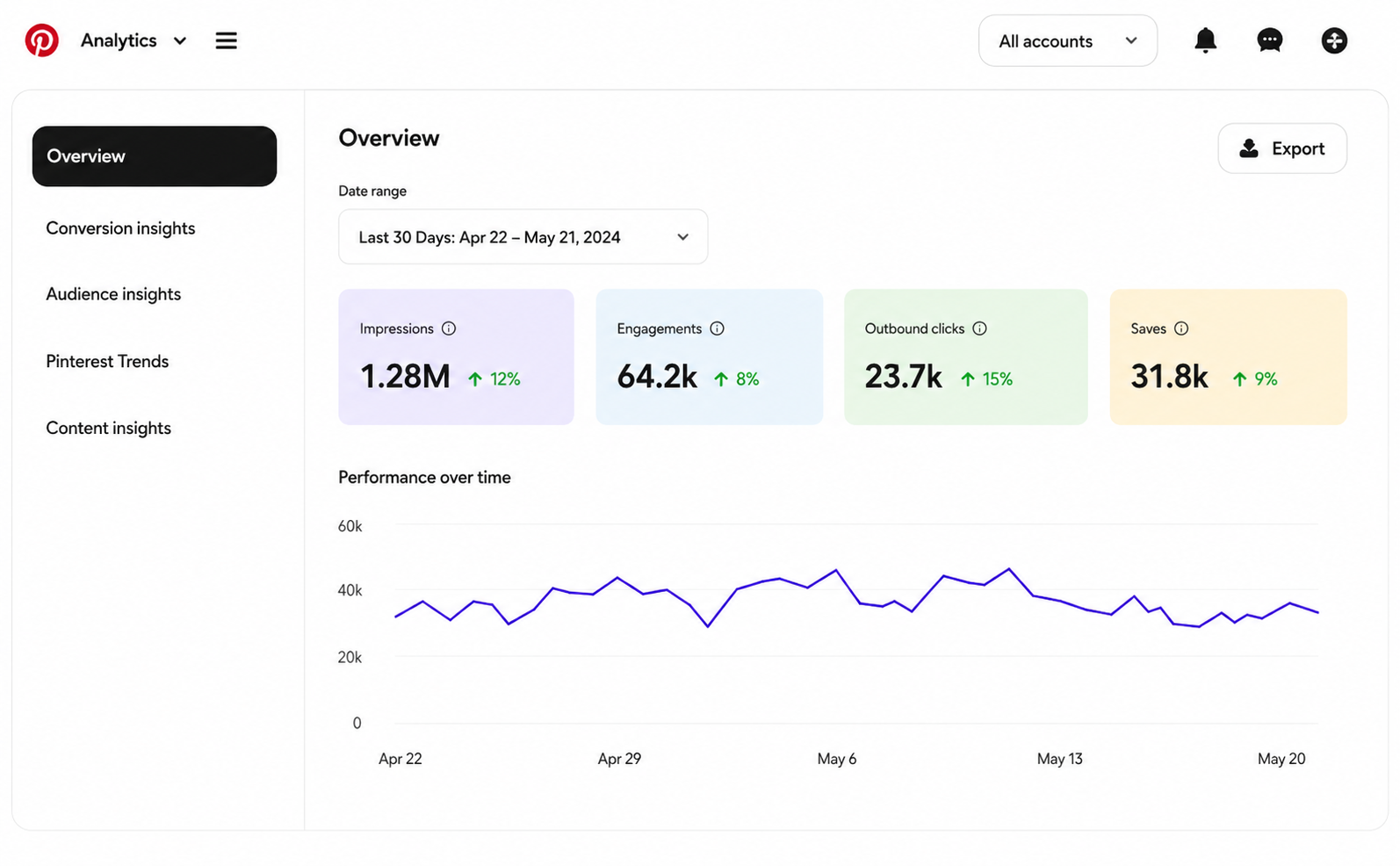
Pinterest Metrics That Actually Matter
You do not need to track every number in Pinterest Analytics. Focus on the metrics that show whether people are discovering your content, clicking through, and taking useful actions after they leave Pinterest.
| Metric | What It Tells You | Why It Matters |
|---|---|---|
| Impressions | How often your Pins appear on Pinterest screens and in search or discovery surfaces. | Useful for measuring visibility, but high impressions alone do not mean your content is driving traffic or revenue. |
| Saves & Engagement | Whether people find your Pin useful enough to save, open, or interact with. | Engagement can show that the topic or creative is resonating, even before it produces strong outbound traffic. |
| Outbound Clicks | How many people click a Pin and continue to your website, product page, store, or other destination. | For traffic-focused strategies, this is one of the clearest signs that your Pin is encouraging people to take the next step. |
| Outbound Click Rate | The percentage of Pin impressions that result in an outbound click. | It helps you compare Pins more fairly and identify which headlines, visuals, and topics are attracting qualified visitors. |
| Conversions | Whether Pinterest visitors complete a meaningful action after clicking, such as a purchase, signup, lead, or inquiry. | Conversions tell you whether Pinterest traffic is actually supporting your business goal, not just generating activity. |
| Revenue | The income attributed to Pinterest visitors through your ecommerce, affiliate, product, or service tracking. | Revenue helps you understand which traffic and offers are producing real business results. |
Do not judge a Pin by impressions alone. A smaller Pin that attracts the right visitors and produces clicks or conversions can be more valuable than one that receives thousands of views without action.
Common Mistakes When Trying to Make Money on Pinterest
Pinterest usually becomes frustrating when you focus on the wrong signals. A Pin can receive impressions or saves and still do very little for your business if it reaches the wrong audience, makes the wrong promise, or sends visitors somewhere that does not help them take the next step.
Creating Pins Before Understanding What People Search For
Attractive graphics are not enough if the topic does not match what people are actually searching for. Start with the problem, idea, or question your audience is trying to solve, then use clear and relevant language in your Pin title, description, and boards.
Trying to Cover Too Many Topics
An account covering unrelated topics can make it difficult to build a clear content direction. Choose a focused audience and a group of related topics you can genuinely help with.
Making the Pin More Exciting Than the Destination
A strong headline may earn a click, but the page after that click still needs to deliver what the Pin promised. If a Pin offers a specific tutorial, idea, or product, visitors should reach a page that continues that same topic.
Sending Traffic to Weak or Irrelevant Pages
Getting someone off Pinterest is only part of the job. Your destination should load properly, match the Pin, answer the visitor’s question, and provide a clear next step.
Measuring Success by Impressions Alone
A Pin with thousands of impressions is not automatically more valuable. A smaller Pin that attracts interested visitors and produces clicks, signups, leads, or sales can contribute much more to your business.
Treating Affiliate Content Like a Link-Dumping Strategy
Affiliate content should help someone make a useful decision rather than simply push a product. Recommend relevant offers, follow each affiliate program’s rules, and clearly disclose material relationships.
Changing Strategy Before You Have Enough Data
One weak Pin does not prove that a niche is bad, and one successful Pin does not mean every similar Pin will perform the same way. Publish consistently enough to see patterns in your topics, creative, clicks, and conversions.
You do not need perfect Pins or a huge audience to build a useful Pinterest strategy. You need clear topics, relevant search intent, honest Pins, useful destinations, and a way to measure what happens after the click.
How to Start: Seven Essential Steps
You do not need to master every part of Pinterest before you begin. Start with a clear goal, build the basic foundation, and improve your strategy as real search and traffic data starts coming in. If you are learning how to make money on Pinterest, these seven steps give you a practical order to follow without trying to master everything at once.
Choose One Monetization Path
Decide what you ultimately want Pinterest traffic to do. That might be buying a product, using an affiliate recommendation, joining an email list, requesting a service, or completing another useful action.
Define Your Niche and Audience
Choose a focused topic and understand the type of person you want your Pins to reach. A clear niche makes it much easier to decide which questions to answer, products to recommend, and content to create.
Choose your Pinterest niche →Set Up Your Pinterest Business Account
Complete your profile, organize useful boards, and make it clear what your account is about. If you have an eligible website, connect and claim it so your Pinterest presence and site can work together.
Business account setup →Research What People Search For
Look for the words, questions, and ideas your audience already uses on Pinterest. Turn those searches into focused content topics rather than creating random Pins and hoping they get discovered.
Create Useful Pins With a Clear Next Step
Design Pins that are easy to understand at a glance. Use readable text, a clear visual hierarchy, and an accurate promise that gives the right person a reason to learn more.
The destination should continue the same idea. A Pin about a specific tutorial, product, or solution should not send the visitor to an unrelated page.
Create Pins that get clicks →Publish, Test, and Stay Consistent
Choose a publishing rhythm you can realistically maintain. Create fresh useful content, test different topics and creative approaches, and plan ahead when your niche has seasonal demand.
Measure What Happens and Improve
Review which Pins are being discovered, which ones earn outbound clicks, and what those visitors do after reaching your destination. Then use those patterns to decide what to create more of.
You do not have to complete all seven steps perfectly before publishing your first Pin. Build the foundation, start creating, and let real data show you what needs improving next.
Pinterest Money-Making Best Practices
A strong Pinterest strategy is not about publishing as many Pins as possible or chasing impressions. Focus on creating content that reaches the right people, earns a useful next step, and supports a clear business goal after the click.
Help First, Promote Second
Create Pins that answer a question, solve a problem, teach something, organize an idea, or help someone make a decision. Promotion feels far more natural when the content is useful before it asks for a click or sale.
Create Around Search Intent
Start with what your audience is actually trying to find. Use relevant search language naturally in your Pin title, description, boards, and content instead of stuffing keywords into every available field.
Keep the Pin and Destination Aligned
The headline and visual may earn attention, but the page after the click has to continue the same promise. Send visitors to the most relevant article, product, resource, or offer rather than a generic page.
Publish Fresh Content You Can Sustain
Build a realistic publishing routine instead of creating a large batch of Pins and disappearing. Test fresh creative, useful topics, and seasonal opportunities while keeping the overall subject of your account consistent.
Measure Actions, Not Just Visibility
Impressions tell you that a Pin was seen. Outbound clicks tell you whether people wanted to continue, while your website, store, or affiliate analytics can show whether those visitors produced a useful result.
Be Clear About Commercial Relationships
If content includes an affiliate relationship, sponsorship, or another material connection, make the relationship easy for the audience to notice and understand. Also check the current rules of the platform, merchant, and affiliate program you are using.
Create something worth discovering, make the next step obvious, and measure whether that journey is genuinely helping both the visitor and your business.
Quick Launch Checklist
Before you start publishing consistently, make sure the basics are in place. You do not need a perfect account, but each Pin should have a clear topic, a relevant destination, and a way to measure what happens next.
Account Foundation
-
✓Choose a focused niche
Know the main topic you cover and the audience you want to help.
-
✓Set up the right account
Use a Pinterest business account when you need business tools and Analytics.
-
✓Complete your profile
Make your name, description, image, and website clearly explain what you offer.
-
✓Create relevant boards
Organize boards around topics your audience is genuinely interested in.
-
✓Prepare a useful destination
Know exactly where people should go after clicking your Pins.
Content and Conversion
-
✓Prepare your keyword topics
Start with real search ideas instead of designing Pins around random topics.
-
✓Create reusable Pin templates
Build a few readable layouts you can adapt without making every Pin identical.
-
✓Check every landing page
Make sure the destination works and continues the promise made by the Pin.
-
✓Add disclosures where required
Make affiliate or commercial relationships clear when they apply.
-
✓Prepare your tracking
Know how you will measure outbound clicks, conversions, leads, or sales.
If these foundations are in place, start publishing. Your first Pins are also part of the research process—use the data they generate to improve your topics, designs, keywords, and destinations over time.
How to Make Money From Pinterest FAQ
Pinterest monetization can feel confusing when you are just getting started. These answers cover common questions beginners have about earning from Pinterest, affiliate links, followers, niches, and how long results may take.
01 Can beginners make money on Pinterest?
Yes. Beginners can use Pinterest to attract people to a blog, product, affiliate recommendation, ecommerce store, digital product, or service. Pinterest usually works as the discovery and traffic source, while the income comes from what visitors do after they click.
If you are learning how to make money on Pinterest, start with one clear niche and one monetization method instead of trying several income strategies at the same time.
02 Do you need a blog to make money on Pinterest?
No. A blog can be useful, but it is not required for every Pinterest monetization strategy. Depending on your business, your Pins may lead to an Etsy listing, ecommerce store, digital-product page, service page, or another relevant destination.
The important part is making sure the destination matches what the Pin promised and gives the visitor a clear next step.
03 How many followers do you need to make money on Pinterest?
There is no single follower number that guarantees Pinterest income. Pinterest discovery can also happen through search, recommendations, and related content, so follower count is only one part of the bigger picture.
For monetization, pay closer attention to relevant impressions, outbound clicks, conversions, leads, and sales rather than focusing only on the size of your follower count.
04 Can you use affiliate links on Pinterest?
Affiliate marketing can be part of a Pinterest strategy, but you should always check the current Pinterest rules and the terms of the affiliate program you are using before publishing direct affiliate links.
Commercial relationships should also be disclosed clearly. Focus on useful and relevant recommendations rather than publishing large numbers of promotional links.
05 How long does it take to make money on Pinterest?
There is no guaranteed timeline. Results can vary based on your niche, search demand, competition, Pin quality, publishing consistency, destination, and monetization method.
Instead of working toward an arbitrary deadline, watch whether relevant impressions, outbound clicks, conversions, and other useful business results improve over time.
06 What Pinterest niches are good for monetization?
Visual and planning-focused topics such as home decor, recipes, fashion, beauty, DIY, crafts, and products can fit Pinterest naturally. Business, education, digital products, wellness, and ecommerce can also work when there is real search interest and a relevant offer behind the traffic.
A good niche should give you enough useful topics to publish consistently while also providing a clear path from discovery to a product, service, resource, or other useful destination.
Pinterest can help people discover your content, but a sustainable monetization strategy depends on what you offer, who reaches it, and what happens after the click.
Conclusion
Turn Pinterest Discovery Into Something Useful
If there is one thing to take away from this guide, it is that Pinterest monetization is not about collecting the largest number of impressions. Pinterest is most useful when it helps the right person discover your content and gives them a relevant reason to take the next step.
That next step might be reading a helpful article, considering an affiliate recommendation, viewing a product, downloading a resource, joining an email list, or learning about a service. The business result happens when that journey continues beyond the Pin.
If you are learning how to make money on Pinterest, keep the beginning simple. Choose a focused topic, decide where your traffic should go, learn what your audience searches for, create useful Pins, and then measure what happens after people click.
You do not need every part of the strategy figured out before you begin. Start with one clear system, collect real data, and improve the parts that are actually helping you reach qualified visitors.
How We Research This Guide
We do not treat a single blog post as the source of truth. When a claim is about how Pinterest works, we start with Pinterest’s own Help Center, business documentation, and policy pages.
For broader strategy, we compare current industry guides and use them as supporting context rather than as a replacement for official platform guidance. Disclosure-related recommendations are also checked against relevant FTC guidance where U.S. endorsement rules may apply.
Pinterest features, policies, and affiliate-program terms can change. Time-sensitive information should therefore be checked again when this guide is substantially updated.
Used for platform features, metrics, account tools, and commercial-content rules.
Pinterest Creator Resources
Used to check current creator tools, affiliate commissions, brand partnerships, audience insights, trends, and Analytics guidance.
View source ↗Pinterest Business Accounts
Used for business-account setup and to verify which business and Analytics tools are associated with this account type.
View source ↗Pinterest Analytics
Used when explaining Pinterest performance data, including impressions, engagement, saves, outbound clicks, and related metrics.
View source ↗Commercial & Affiliate Content Guidelines
Used to check Pinterest’s rules around affiliate content, commercial transparency, originality, relevance, and spammy behavior.
View policy ↗FTC Endorsement & Disclosure Guidance
Used when discussing sponsored recommendations, material relationships, affiliate disclosures, and clear disclosure practices.
View guidance ↗Used for additional context and comparison—not as a substitute for Pinterest’s own rules.
Shopify Pinterest Marketing Guide
Used for additional ecommerce and marketing context around Pinterest discovery, traffic, content, and business outcomes.
View source ↗Buffer Pinterest Guide
Used for additional creator and business context around account setup, Pinterest discovery, publishing, keywords, and measurement.
View source ↗Start With the Foundation
If you are new to Pinterest, do not try to master SEO, traffic, affiliate marketing, and monetization all at once. Start with the basics, build your account properly, and understand how Pins, boards, keywords, and destinations work together.
The beginner guide walks you through the setup in a clear order so you can build the foundation before moving into Pinterest SEO, traffic growth, and monetization.
Start with Pinterest for BeginnersAccount setup, boards, Pins, keywords, and the first steps to building a useful Pinterest system.